Skip to content

Rework is a quality problem.

A quality issue might start small. It becomes costly when the next trade builds on top of it.

Sablono puts Hold and Witness Points directly into the flow of work, so critical checks happen before following work is released.

Catch it early. Get it right first time. Keep moving.

The same defect, found at four different moments

One unsealed penetration in a riser wall. Nothing about the defect changes. What changes is how much of the building has been built over it.


AT THE CHECK BY THE NEXT TRADE AT HANDOVER AFTER OCCUPATION
Twenty minutes Half a shift, two crews Weeks, and a held unit A claim, and your record
The crew is still in the room with the materials out. The seal is finished properly and the activity signs off the same shift. Boarding is stripped back, the M&E crew returns, and two trades lose a slot in the sequence. Somebody starts a conversation about who pays. Finishes come off, access is negotiated with three parties, and the unit cannot be signed over while it is open. The programme absorbs it or the date moves. Access to an occupied flat, a remediation contractor, and a dispute about who was responsible — argued from whatever evidence anyone kept.


Every rework conversation is really a conversation about which of these four columns your process puts you in.

HOW SABLONO HELPS

Sablono keeps your team in the first column

None of this is extra process. It is your existing sequence, with the checks placed where the cost of missing them changes.
HOLD POINTS & SIGN-OFF

Quality gates before work moves on

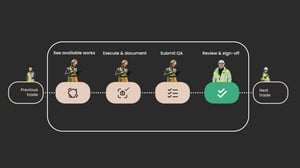
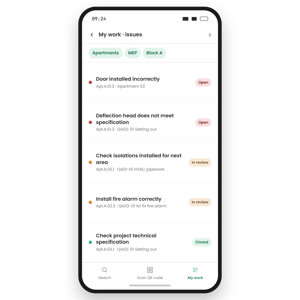
Until all checks pass and the sign-off lands, the next activity stays closed, and the crew waiting on it can see that from their phone before they walk to the room. Once the work is handed over, receiving crews can raise additional issues when they find them.
QA Workflow with next trade
ROOT-CAUSE ANALYTICS

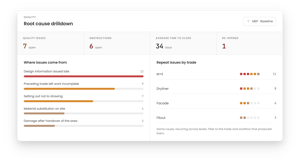
Stop fixing instances. Fix the cause.

Catching a defect on unit 40 saves one unit. Noticing that the same defect has appeared on 22 units, all from one crew and one detail, saves the remaining 44 — and the next project.

Because every issue is raised from a template against an activity and a trade, the pattern is a filter rather than a hunch. A toolbox talk on Tuesday is cheaper than forty-four remedials in month nineteen.

quality 1.1
TRACKTrace LP (4)
BUILT ON CONFIDENCE
92% of users say Sablono gives them peace of mind around quality reporting

“What truly impressed us about Sablono was how effortlessly it gives us full traceability over every detail of our projects. It’s rare to find a system that’s this powerful yet so easy for our teams to use. It’s rapidly transforming how we track progress, resolve issues, and keep everyone aligned.”
Jean-Baptiste Lugger Construction Manager, FT Construction 

10,000+
Residential units delivered with Sablono 
Never be in the dark about quality again
Getting it right first time just became easier.
TRACKTrace LP (2)
Stay compliant
Always have the right quality documentation to ensure compliance.
Copy of QA LP (15)
Less admin, more action
Save time by reporting quality directly from the site. 
TRACKTrace LP (3)
Reduce risk & rework
Keep track of quality by capturing quality against the programme in a single platform.
Copy of QA LP (290 x 256 px) (8)
Quality and compliance — built into your workflow
Sablono Trace empowers teams to capture, verify, and deliver quality work on schedule.

Spot issues before they become problems

“The real-time, day-to-day tracking has allowed us to spot and resolve issues before they become costly. We can now see live updates on screen as work happens on site. Before Sablono, everything was manual — we’d jot notes on paper, take photos, and mark things up on walls.” - Stephen Horrocks, Senior Project Manager, Domis Construction

FAQs

What is the difference between a hold point and a witness point? A hold point stops the following activity until the check has passed and been signed off. A witness point additionally requires a named party to be present for the check — a client inspector, a fire consultant, building control. Sablono raises both from the programme and notifies whoever is needed.
Doesn't gating the sequence slow the programme down? It changes where the time goes. A held unit costs hours; a unit reworked after the following trade has closed it over costs days, and usually somebody's contingency. Teams report the sequence running faster overall because crews stop turning up to rooms that were not ready.
What stops someone just marking the check as passed? The check requires its evidence — the required fields and the photographs — before it can be signed, and sign-off can be assigned to someone other than the trade doing the work. The approval carries a name and a timestamp, so a rubber-stamped check is visible as one later.
Can subcontractors use it without training overhead? The site side is a phone. Scan the room, see the checks for that activity, complete them, attach the photographs. Most crews are productive on it the same day, which matters because a system trades will not use produces no record at all.
How do we know where our rework is actually coming from? Issues are raised from templates against an activity and a trade, so the same three cuts — by trade, by activity, by level — surface the patterns. Most projects find a small number of issue types account for the bulk of the remedial work.
Where should we put the first gates?

Wherever the work is about to be covered up, and wherever a following trade inherits the condition. Firestopping, penetrations, cavity barriers, waterproofing and pre-close inspections are the usual first four, and they tend to pay for the whole exercise.